Sounds of the Subconscious Seas
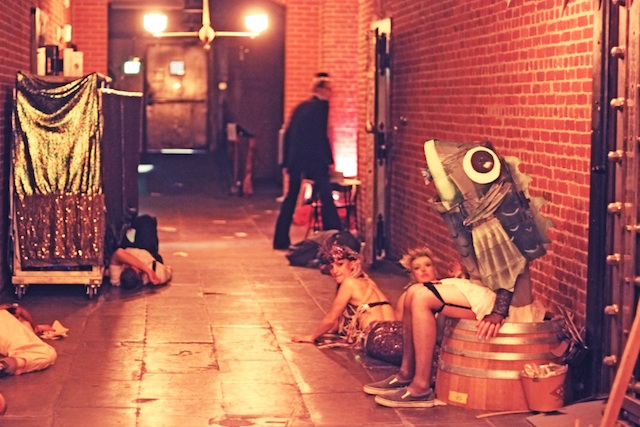
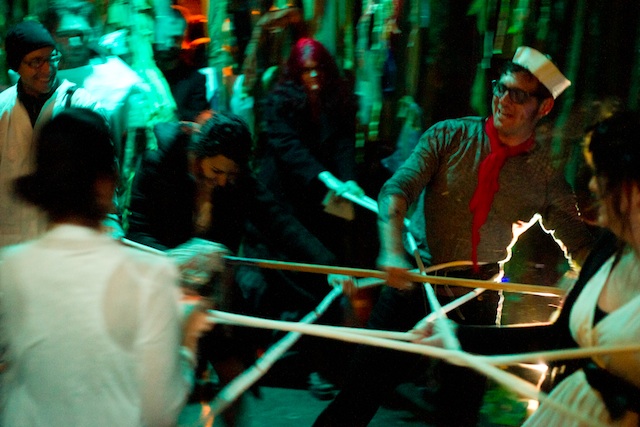
Generative soundscape for immersive theater exhibit at the All Worlds Fair event in the basement of the San Francisco Mint building.
Generative sound engine built with SuperCollider. Sounds from various sources and modified with Ableton Live.
Sounds of the subconscious seas.

A Soundscape for the "Seas of the Subconscious" experience that took place in the basement of the San Francisco Mint building for the 2013 "All Worlds Fair".
The soundscape is generative, so it can be infinitely long. Here is a sample:
It is written in SuperCollider, start of my framework for developing soundscapes:
github.com/colinsullivan/seas-of-subconscious
SuperCollider
Checkout this play method of my SoundscapeElement class. This class is a parent class of all elements in the soundscape that are triggered at a particular rate
/**
 *  @file       SoundscapeElement.sc
 *
 *  @author     Colin Sullivan <colin [at] colin-sullivan.net>
 *
 *              Copyright (c) 2013 Colin Sullivan
 *              Licensed under the MIT license.
 **/

/**
 *  @class  Base class for all soundscape elements that are triggered with
 *  a particular frequency.
 **/
SoundscapeElement : Object {
  var <>outChannel,
    /**
     *  A unique symbol to use for this element.  Override in child
     *  classes.
     **/
    <>key,
    // reference to Soundscape instance
    <>soundscape,
    // instrument we are triggering
    <>instr,
    // transition on and off envelope duration
    <>transitionTime,
    // maximum time this sound will be played for
    <>onTimeMax,
    // minimum time this sound will be played for
    <>onTimeMin,
    // minimum duration between previous off and next on
    <>offTimeMin,
    // maximum duration between previous off and next on
    <>offTimeMax,
    // amount of reverb :)
    <>reverbLevel;

  ...

  /**
   *  Called from soundscape when it starts up.
   **/
  play {
    var onTime,
      offTime;

    /**
     *  Main run loop.
     **/
    {

      while({ true }, {

        // prepare instrument
        this.instr = this.create_next_patch();
        this.outChannel.play(this.instr);

        // wait for the desired off time
        offTime = rrand(this.offTimeMin, this.offTimeMax);
        offTime.wait();

        // turn sound on
        this.instr.set(\gate, 1);

        // wait for transition time
        this.transitionTime.wait();

        // wait for on time
        onTime = rrand(this.onTimeMin, this.onTimeMax) - (2.0 * this.transitionTime);
        onTime.wait();

        // turn sound off
        this.instr.set(\gate, 0);

        // off envelope time is same as on time
        this.transitionTime.wait();

        // stop patch (just for safety)
        this.instr.stop();

      });

    }.fork();

  }
}
Then to use this superclass, I only have to define a few member variables and write the method that creates the patch. There are a few other things that I didn't have time to move to the superclass as well, like creating the mixer channel for the reverb.
/**
 *  @file       FogHornElement.sc
 *
 *  @author     Colin Sullivan <colin [at] colin-sullivan.net>
 *
 *              Copyright (c) 2013 Colin Sullivan
 *              Licensed under the MIT license.
 **/

/**
 *  @class  Foghorn action.
 **/
FogHornElement : SoundscapeElement {
  var <>outLevelMin,
    <>outLevelMax,
    <>bufKeys;

  init {
    arg args;

    super.init(args);

    this.outChannel.newPreSend(
      this.soundscape.reverbReturn,
      -10.0.dbamp()
    );

    this.bufKeys = [\fogHornBuf, \fogHorn02Buf];

    this.outLevelMin = -18.0.dbamp();
    this.outLevelMax = -20.0.dbamp();

    this.offTimeMin = 30.0;
    this.offTimeMax = 80.0;
    /*this.offTimeMin = 5.0;*/
    /*this.offTimeMax = 5.0;*/

    this.transitionTime = 0.1;
  }

  create_next_patch {
    var bufKey,
      bufSection,
      buf;

    super.create_next_patch();

    bufKey = this.bufKeys.choose();
    buf = this.soundscape.bufs[bufKey];

    ("preparing fog horn" ++ bufKey).postln();

    this.onTimeMin = buf.duration;
    this.onTimeMax = buf.duration;

    this.outChannel.level = rrand(this.outLevelMin, this.outLevelMax);

    ^Patch("cs.sfx.PlayBuf", (
      buf: buf,
      attackTime: this.transitionTime,
      releaseTime: this.transitionTime,
      gate: KrNumberEditor.new(0, \gate.asSpec())
    ));
  }
}